Event JSON
{
"id": "16911d91bf5fbe255b0adb0b4568d4dec2c89fe33876dcb4a2ebb28d503de353",
"pubkey": "f8f4fe83e020824e25b3effd9a69f8268654b25205d6a385090ed4c7ce5c5c92",
"created_at": 1764317723,
"kind": 1,
"tags": [
[
"t",
"linux"
],
[
"t",
"kernel"
],
[
"t",
"xserver"
],
[
"t",
"x11"
],
[
"t",
"wayland"
],
[
"t",
"linuxkernel"
],
[
"t",
"evdev"
],
[
"imeta",
"url https://media.hachyderm.io/media_attachments/files/115/626/316/794/581/412/original/faa3507fbfebc2d5.png",
"m image/png",
"dim 880x826",
"blurhash UFSF-GM}~p_2r^xtx[IV-nocR.e?-:V]R,t6"
],
[
"proxy",
"https://hachyderm.io/users/kernellogger/statuses/115626326356756727",
"activitypub"
],
[
"client",
"Mostr",
"31990:6be38f8c63df7dbf84db7ec4a6e6fbbd8d19dca3b980efad18585c46f04b26f9:mostr",
"wss://relay.ditto.pub/"
]
],
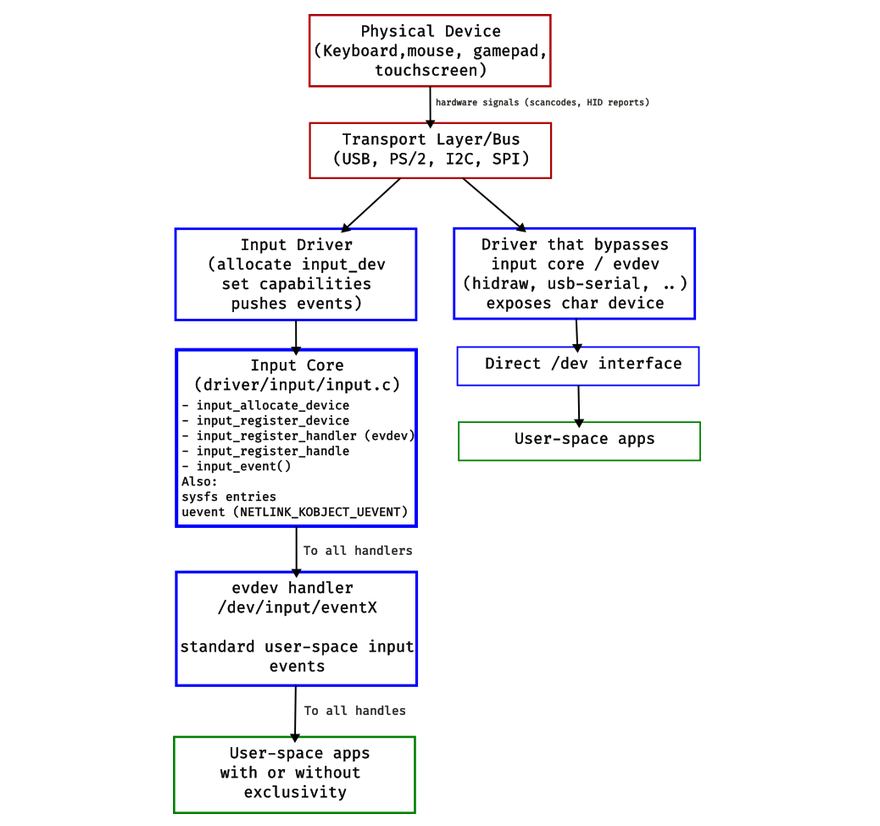
"content": "The Input Stack on Linux – An End-To-End Architecture Overview\n\nhttps://venam.net/blog/unix/2025/11/27/input_devices_linux.html\n\nPatrick Louis writes: \"\"Let’s explore and deobfuscate the input stack on #Linux. Our aim is to understand its components and what each does. Input handling can be divided into two parts, separated by a common layer:\n\n #Kernel-level handling: It deals with what happens in the kernel and how events are exposed to user-space\n […]\n Exposed layer (middle)\n […]\n User-space handling:\n […]\n The Widgets, #XServer, #X11 window managers, and #Wayland compositors, which rely on everything else\n\nWe’ll try to make sense of all this, one thing at a time, with a logical and coherent approach.\"\"\n\n#LinuxKernel #evdev\n\nhttps://media.hachyderm.io/media_attachments/files/115/626/316/794/581/412/original/faa3507fbfebc2d5.png",
"sig": "bd3c583484248633159b89c29ff6651169bc4e9ff33b2b2f9774bd376e83ced78131364972651fd53b312f8622ef36493f427b6cc71ee12a76abf5de6981cafa"
}