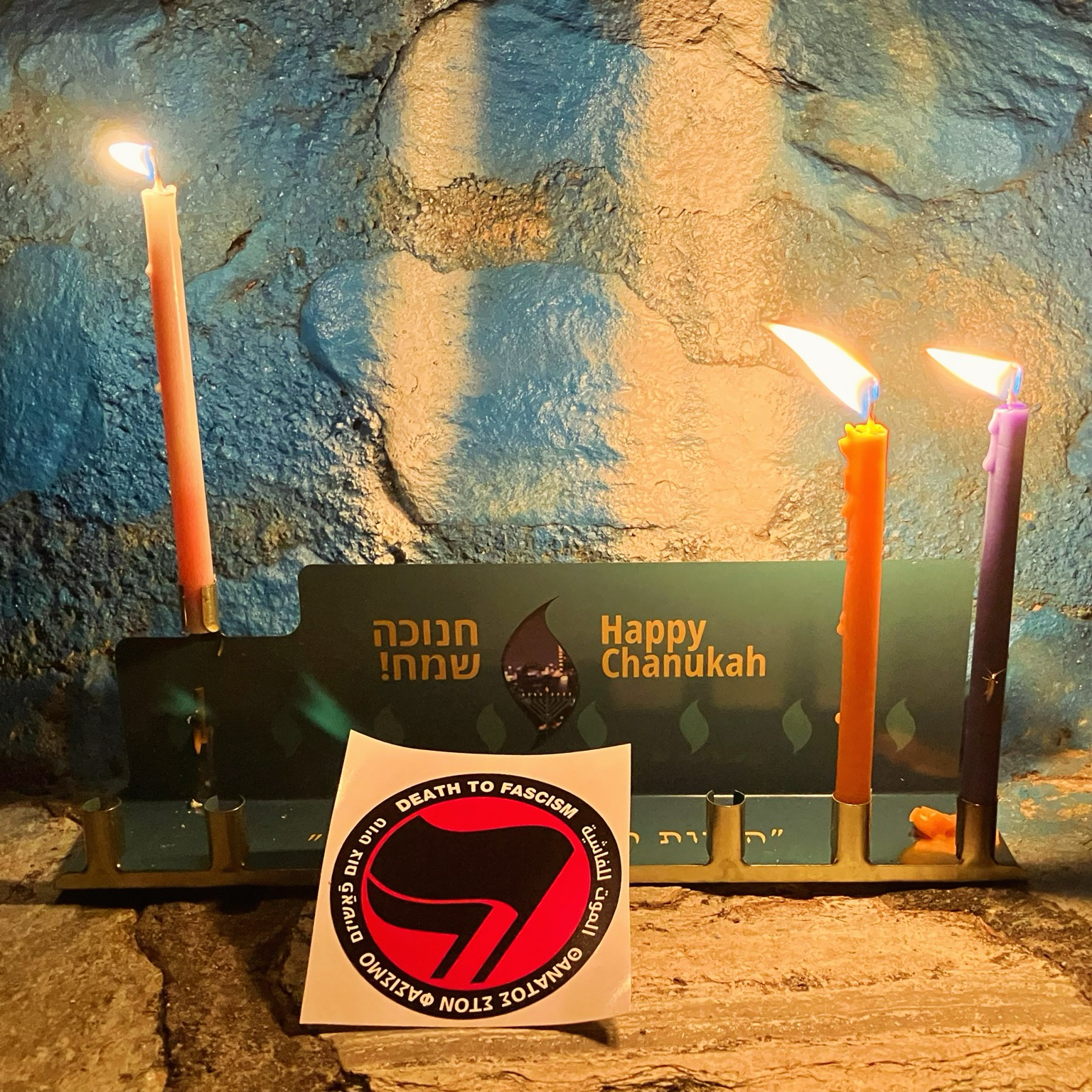
I light the candles this second night not as a “festival of light” but rather to illuminate the horror of logics that kill. That kill off people, of blessed memory, and also kill off cultures, languages, and traditions. That kill off stories, art, spirituality, foods, and humor. That kill off diversity, cross-pollination, and solidarities between and among various peoples.
I light candles in public not to bask in bright flames cheerfully dancing before my eyes but instead to (re)assert bravery despite a nagging worry that it isn’t safe or smart to be Jewish out in the open. What if someone walks by, sees the Hebrew on my not-so-beautiful but free Chabad menorah, and assumes the worst, turning me into a caricature of their worst nightmare about Jews? What if the antisemitism I read in too much of the unnuanced street art filling up so many walls here is directed at me, the rare Jewish person here, who like Jews in so many places these days has to pass a litmus test not applied to non-Jews?
My candles barely stay lit, flickering in and out, as if feeling the same sense of loss and sorrow, trauma and anxiety, that I do on this blood-stained Chanuka, as if whispering the Mourners’ Kaddish on the wind, hoping it will reach Sydney.
This should be a playful, light-filled holiday, but sparks of joy are hard to discern.
Instead, I find strength in the tiniest of interventions against this fascistic world—a world where antisemitism, Islamophobia, xenophobia, and racism are palpable and deadly: setting my menorah on a path in a park, where anyone might see it; adding the offering of a new sticker, intended to counter some of the street art via its antifascism in four languages—Greek and English, and generatively provocative (I hope), Arabic and especially Yiddish.