John Carlos Baez on Nostr: HARDCORE MATH POST Take the E₁₀ Dynkin diagram at right. This gives the surface ...
HARDCORE MATH POST
Take the E₁₀ Dynkin diagram at right. This gives the surface at left, with 10 circles drawn on it.
Cut the surface at each of the 10 circles, twist those circles by 360 degrees, and glue it back together. This process defines a map from the surface to itself, whose action on the first homology group of the surface gives a linear transformation. The largest eigenvalue of this linear transformation is 'Lehmer's number':
λ ≈ 1.17628
What's so great about Lehmer's number? Among all algebraic integers greater than 1, it's conjectured to be the one with the smallest absolute value! 😲
In case you don't know: an 'algebraic integer' is a root of a polynomial with integer coefficients, where the top coefficient is 1. Algebraic integers act a lot like integers, and the rational ones are just ordinary integers. Lehmer's number is the largest real root of the polynomial
f(x) = x¹⁰ + x⁹ - x⁷ - x⁶ - x⁵ - x⁴ - x³ + x + 1
It's completely mysterious to me why this would be the algebraic integer greater than 1 with the smallest absolute value. But I know E₁₀ has connections to lots of great things: for example, it gives a discrete group of symmetries of a hyperboloid in 10-dimensional Minkowski spacetime, which can also be defined using the octonions, and shows up in supergravity.
For more see:
• Eriko Hironaka, What is Lehmer's number?,
https://www.ams.org/notices/200903/rtx090300374p.pdf 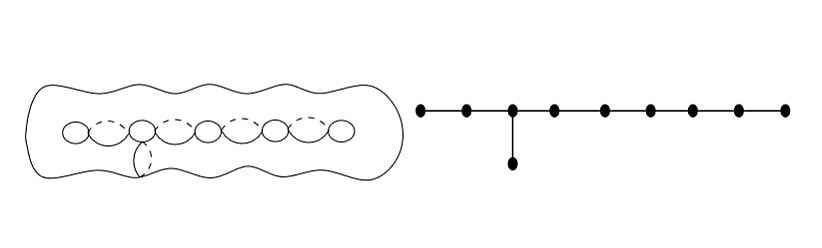
Published at
2025-04-13 20:56:15 UTCEvent JSON
{
"id": "72ca086765c404077bbf2cac25c16369db874e585a24a664bd0ae18d1d388890",
"pubkey": "f7346eb283902ada9d21c109a93e83128d9f87d8fcfe70ad819b3bf2ad9bce16",
"created_at": 1744577775,
"kind": 1,
"tags": [
[
"imeta",
"url https://media.mathstodon.xyz/media_attachments/files/114/332/583/243/524/638/original/6a5e1ab816cd2c14.jpg",
"m image/jpeg",
"dim 822x248",
"blurhash U5S~x5M{t7t7xut7fQay~qt7WBay%MM{fQof"
],
[
"proxy",
"https://mathstodon.xyz/users/johncarlosbaez/statuses/114332649121342826",
"activitypub"
],
[
"client",
"Mostr",
"31990:6be38f8c63df7dbf84db7ec4a6e6fbbd8d19dca3b980efad18585c46f04b26f9:mostr",
"wss://relay.mostr.pub"
]
],
"content": "HARDCORE MATH POST\n\nTake the E₁₀ Dynkin diagram at right. This gives the surface at left, with 10 circles drawn on it.\n\nCut the surface at each of the 10 circles, twist those circles by 360 degrees, and glue it back together. This process defines a map from the surface to itself, whose action on the first homology group of the surface gives a linear transformation. The largest eigenvalue of this linear transformation is 'Lehmer's number':\n\nλ ≈ 1.17628\n\nWhat's so great about Lehmer's number? Among all algebraic integers greater than 1, it's conjectured to be the one with the smallest absolute value! 😲 \n\nIn case you don't know: an 'algebraic integer' is a root of a polynomial with integer coefficients, where the top coefficient is 1. Algebraic integers act a lot like integers, and the rational ones are just ordinary integers. Lehmer's number is the largest real root of the polynomial\n\nf(x) = x¹⁰ + x⁹ - x⁷ - x⁶ - x⁵ - x⁴ - x³ + x + 1\n\nIt's completely mysterious to me why this would be the algebraic integer greater than 1 with the smallest absolute value. But I know E₁₀ has connections to lots of great things: for example, it gives a discrete group of symmetries of a hyperboloid in 10-dimensional Minkowski spacetime, which can also be defined using the octonions, and shows up in supergravity.\n\nFor more see:\n\n• Eriko Hironaka, What is Lehmer's number?, https://www.ams.org/notices/200903/rtx090300374p.pdf\n\nhttps://media.mathstodon.xyz/media_attachments/files/114/332/583/243/524/638/original/6a5e1ab816cd2c14.jpg",
"sig": "13bec35ca29b90abc507ea9ec0f8880c8f9317f3d51b908f1a873447e20002aef43239d9919701323bcf5c289dc8a6c1f2a93499e22dce8448b0f5764ec4141f"
}