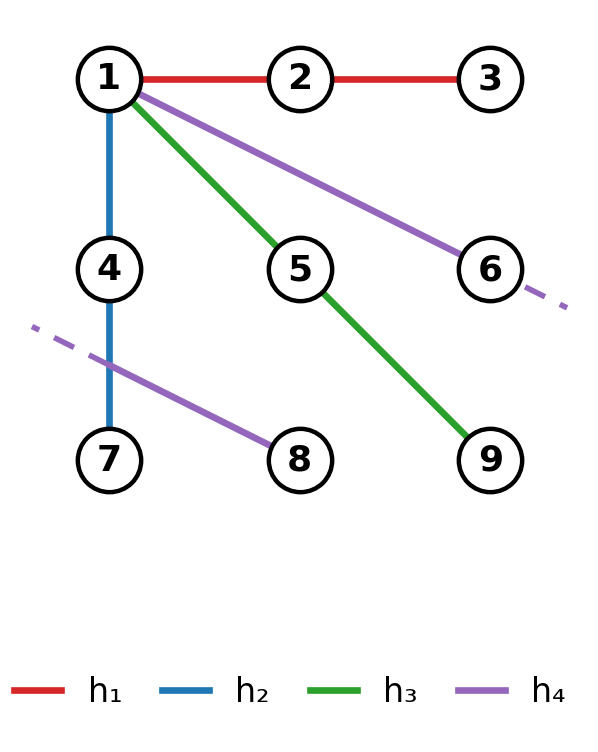
They showed that up to the action of SL(n), every trivector is a linear combination of these 4 trivectors:
h₁ = x₁∧x₂∧x₃ + x₄∧x₅∧x₆ + x₇∧x₈∧x₉
h₂ = x₁∧x₄∧x₇ + x₂∧x₅∧x₈ + x₃∧x₆∧x₉
h₃ = x₁∧x₅∧x₉ + x₂∧x₆∧x₇ + x₃∧x₄∧x₈
h₄ = x₁∧x₆∧x₈ + x₂∧x₄∧x₉ + x₃∧x₅∧x₇
This looks very scary - almost random! But look at the first term in each sum:
x₁∧x₂∧x₃
x₁∧x₄∧x₇
x₁∧x₅∧x₉
x₁∧x₆∧x₈
Compare it to the chart below. In this chart, I've drawn a 3×3 grid, and all lines through the upper left-hand corner, where the purple line "wraps around". Each line has three points on it! And these points are
1 2 3
1 4 7
1 5 9
1 6 8
matching the pattern we just saw!
But that only explains the first term in each trivector h₁,h₂,h₃,h₄. Can you guess the pattern that explains other two terms in each trivector? I'll show you.
(4/n)