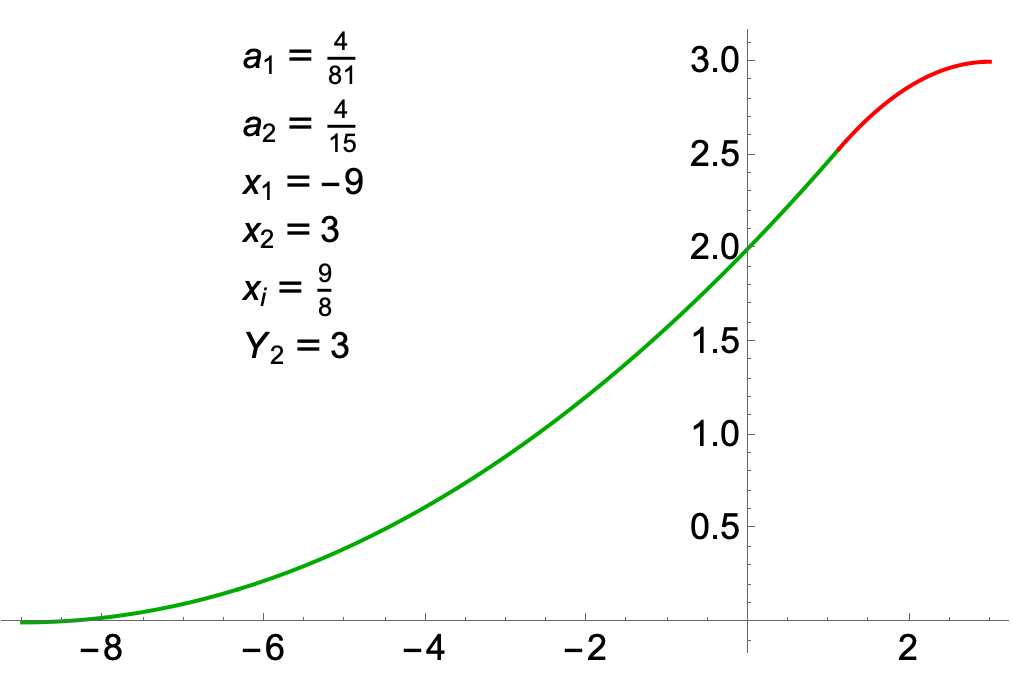
y₁(x) = ½ a₁ (x–x₁)²
so it starts with a derivative of zero at x=x₁, y=0 and accelerates at a rate of a₁.
Suppose the second parabola is:
y₂(x) = Y₂ – ½ a₂ (x–x₂)²
so it ends up at x=x₂, y=Y₂ with a derivative of zero, after decelerating at a rate of a₂.
You can find the x value where they intersect by setting:
y₁(x) = y₂(x)
which gives a quadratic equation in x that is solved by the first of two roots:
xᵢ = (a₁x₁+a₂x₂–√[2(a₁+a₂)Y₂–a₁a₂(x₁–x₂)²]) / (a₁+a₂)
In order for the two parabolas to join up smoothly, their derivatives at x=xᵢ must be equal:
y₁'(xᵢ) = y₂'(xᵢ)
This condition simplifies to give:
2(a₁+a₂)Y₂ = a₁a₂(x₁–x₂)²
This also means the quadratic we got earlier actually has only one root, i.e.the two parabolas intersect at a single point rather than two points. If you think about the geometry that makes sense, because the two parabolas then are tangent to each other at the point where they meet.
You can solve this condition to find x₂ in terms of Y₂, which is how I think your problem is set up:
x₂ = x₁ + √[2(a₁+a₂)Y₂ / (a₁+a₂)]
and then you also have:
xᵢ = (a₁x₁+a₂x₂) / (a₁+a₂)
where xᵢ is the value for x that gives a smooth transition between the parabolas.