John Carlos Baez on Nostr: This prediction market poses a fascinating question. How many Erdős problems will be ...
This prediction market poses a fascinating question. How many Erdős problems will be solved by the end of the year? If you believe that "AI has solved mathematics", you'll probably think lots. I imagine that's why more people say over 700 will be solved than 600-699. If you're less optimistic about AI, you'll probably think fewer.
A lot depends on things I don't know, like: are AI companies throwing their software at all the remaining 652 Erdős problems, not getting anywhere yet, and keeping quiet about it?
Here's what I think:
Not only did Gödel show many math problems are unsolvable, he showed that many problems we *can* in theory solve have solutions that are so long we'll never find them! And we often can't tell which problems these are. In fact, sometimes it's impossible to show an unsolvable problem is unsolvable!
But there are many mysteries here. It's possible that all "sufficiently interesting" problems about arithmetic are solvable - so that Erdős problems, being interesting, can be solved. But I don't see why this should be true.
It's also possible that lots of interesting conjectures are true "by chance", not for any good reason that can be captured in a proof. It might seem odd to bring randomness into math this way, but Chaitin figured out how it makes sense. I think a good candidate for a conjecture that's true by chance is the Collatz conjecture: it has a kind of pseudo-randomness built into it. But I haven't checked to see if any Erdős problems have this flavor.
I like how despite all the deep unknown or unknowable mysteries here, we'll know by the end of 2026 how many Erdős problems are solved. Just for fun, I bet ≤599.
https://manifold.markets/JimMcMillan/how-many-erdos-problems-will-be-mar 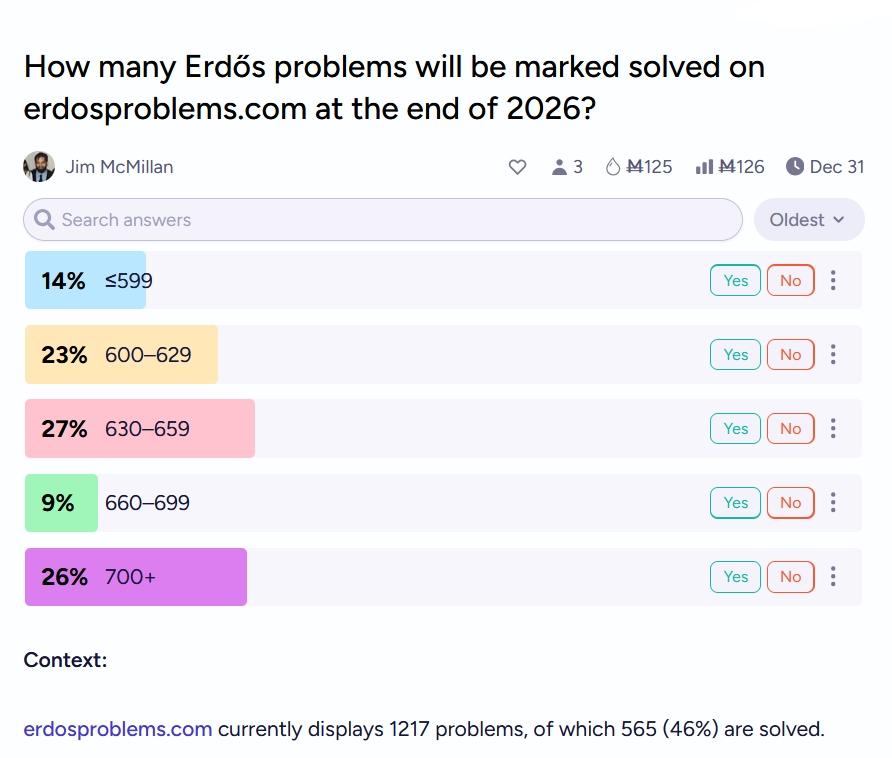
Published at
2026-08-16 11:52:15 UTCEvent JSON
{
"id": "6e9f1600558920e813840690b73c48e7ac7181ab55ee33475490afc05f5c7167",
"pubkey": "9a6a1a8eefd0b53d7e0c966ab35bd904151246f03b1be98fa0d2d0eeb4940320",
"created_at": 1786881135,
"kind": 1,
"tags": [
[
"proxy",
"https://mathstodon.xyz/@johncarlosbaez/117105042105698101",
"web"
],
[
"imeta",
"url https://media.mathstodon.xyz/media_attachments/files/117/104/946/919/126/025/original/e71f6e181607630a.jpg",
"m image/jpeg"
],
[
"proxy",
"https://mathstodon.xyz/users/johncarlosbaez/statuses/117105042105698101",
"activitypub"
],
[
"L",
"pink.momostr"
],
[
"l",
"pink.momostr.activitypub:https://mathstodon.xyz/users/johncarlosbaez/statuses/117105042105698101",
"pink.momostr"
],
[
"-"
]
],
"content": "This prediction market poses a fascinating question. How many Erdős problems will be solved by the end of the year? If you believe that \"AI has solved mathematics\", you'll probably think lots. I imagine that's why more people say over 700 will be solved than 600-699. If you're less optimistic about AI, you'll probably think fewer. \n\nA lot depends on things I don't know, like: are AI companies throwing their software at all the remaining 652 Erdős problems, not getting anywhere yet, and keeping quiet about it? \n\nHere's what I think:\n\nNot only did Gödel show many math problems are unsolvable, he showed that many problems we *can* in theory solve have solutions that are so long we'll never find them! And we often can't tell which problems these are. In fact, sometimes it's impossible to show an unsolvable problem is unsolvable!\n\nBut there are many mysteries here. It's possible that all \"sufficiently interesting\" problems about arithmetic are solvable - so that Erdős problems, being interesting, can be solved. But I don't see why this should be true.\n\nIt's also possible that lots of interesting conjectures are true \"by chance\", not for any good reason that can be captured in a proof. It might seem odd to bring randomness into math this way, but Chaitin figured out how it makes sense. I think a good candidate for a conjecture that's true by chance is the Collatz conjecture: it has a kind of pseudo-randomness built into it. But I haven't checked to see if any Erdős problems have this flavor.\n\nI like how despite all the deep unknown or unknowable mysteries here, we'll know by the end of 2026 how many Erdős problems are solved. Just for fun, I bet ≤599.\nhttps://manifold.markets/JimMcMillan/how-many-erdos-problems-will-be-mar\nhttps://media.mathstodon.xyz/media_attachments/files/117/104/946/919/126/025/original/e71f6e181607630a.jpg\n",
"sig": "68b8d8cfed54169278c2e4c6d11b7e256a6a8a9b362dbac4d7d63e14a3f559ba957114a580a4705e18c0c87dc44a7c4e46bfcc5bcc3f256171619e8df199c931"
}