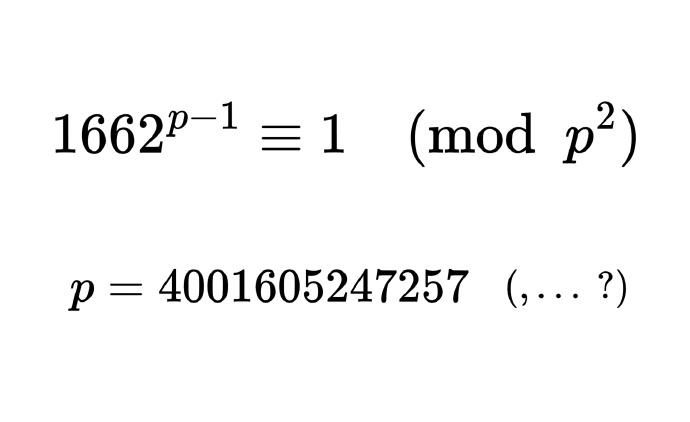
\( 1662^{p-1} \equiv 1 \pmod{p^2} \) .
In this case,𝑝=4001605247257.
Previously, no prime below 4 trillion had been found to satisfy this congruence. The discoverer was Richard Fischer.https://www.fermatquotient.com/FermatQuotienten/FermQ_Sorg.txt
But there is deeper mathematics here: it is not merely the discovery of a curious prime. From this, one can deduce that there exists a natural number 𝑛 such that the ring of integers of \(\mathbb{Q}(\sqrt[n]{1662})\) is not \( \mathbb{Z}[\sqrt[n]{1662}] \) . The smallest such example is precisely 𝑛=4001605247257.
In the literature (https://kconrad.math.uconn.edu/blurbs/gradnumthy/integersradical.pdfsee Theorem 5.3), it is stated:
When 𝑎≠±1,𝑛≥2, and \( T^n - a\) is irreducible over 𝑍,the ring of integers of \(\mathbb{Q}(\sqrt[n]{a})\) equals \( \mathbb{Z}[\sqrt[n]{a}] \) if and only if 𝑎 is square-free, and none of the prime divisors of 𝑛 is a Wieferich prime to base 𝑎.
Thus, when 𝑎=1662, the polynomial \( 𝑇^𝑛−1662 \) satisfies:−1662 is divisible by 2 but not by 4,
all middle coefficients are 0, hence divisible by 2,the leading coefficient (=1) is not divisible by 2.
Therefore, by Eisenstein’s criterion with 𝑝=2,\( 𝑇^𝑛−1662 \) is irreducible over 𝑄.
Since 1662 is square-free, for all 𝑛 less than the Wieferich prime to base 1662 (namely
4001605247257), the ring of integers is \( \mathbb{Z}[\sqrt[n]{1662}] \) .
Similarly, for \(\mathbb{Q}(\sqrt[n]{2})\) , when 𝑛=1093, the ring of integers is not \( \mathbb{Z}[\sqrt[n]{2}] \) , because 1093 is the classical Wieferich prime to base 2.