
Finally Flying the F-5: A Bucket List Item
Air Facts Journal
I have been fortunate to fly in numerous Navy jet fighters. The Air Force didn’t think I was pilot material—some obscure medical issue—but the Navy gave me the chance. As a young civilian aeronautical engineer at Naval Air Test Center Patuxent River, I worked in Carrier Suitability Flight Test and flew as an F-14 RIO (Radar Intercept Officer), plus time in the F-4, KA-6D, and TA-7C. As a RIO, my main task was to align the inertial navigation system. My real job was as a flight test engineer with Carrier Suitability, which had a large fleet of flight test planes including the A-3, A-4, F-8, RA-5C, S-3A, etc., all designed with that beefy Navy tail hook for those carrier traps.
Over the years, one jet always appealed to me because of its sleek lines and just pure sex appeal. Countless air shows, air races, and military base visits afforded me the chance to admire F-5s in person and even grab occasional cockpit time, but I wanted to fly one. The F-5 does have a tail hook, but not the type used for carrier landings, and thus I never worked with this plane in Carrier Suitability. Since I go back to the 1950s (OK, you can do the math), my time window was getting shorter to fly one of my favorite jets.
I have had the opportunity to cross paths with many fine aviators. Scott “Gomex” Glaser is one who formed Aerospace Operations (AO) in Mojave, California. AO’s focus is on aerospace flight testing, advanced aerospace training, and advanced operations. In recent years, Scott has organized the Star Wars Canyon Run for individual aircraft owners. It has been an eye-opening experience to fly Star Wars Canyon in both piston and jet aircraft. During these visits, my interest in the F-5 was rekindled.
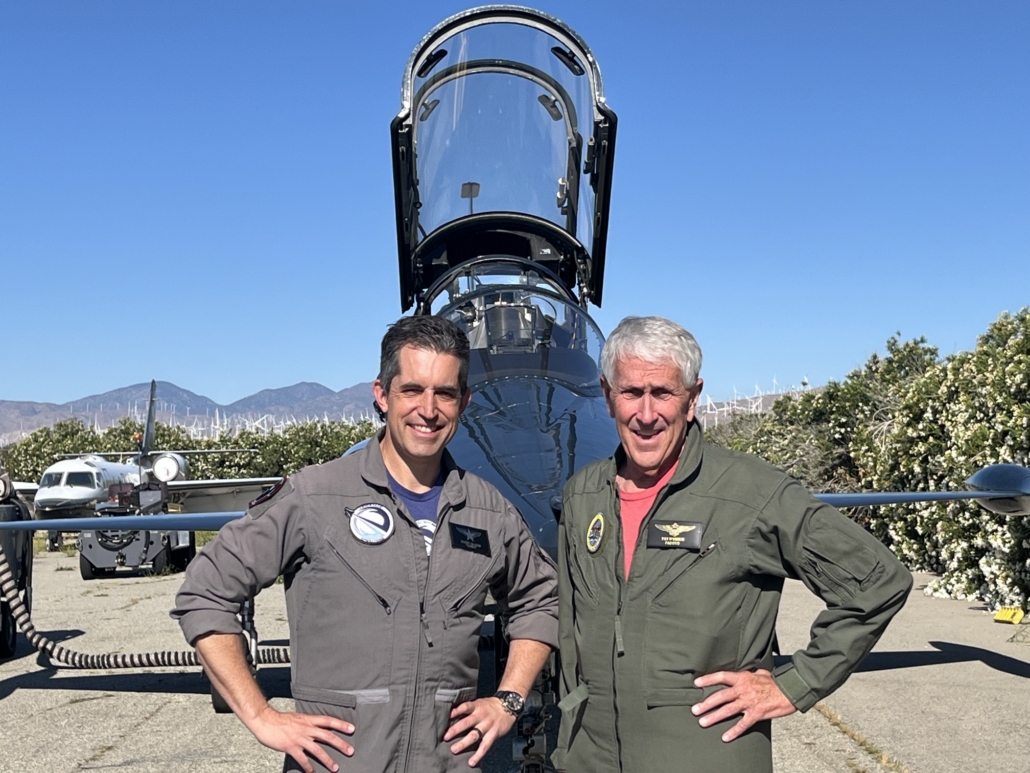
Gomex and PaddyO ready for the F-5 hop.
AO operates a fleet of aircraft, but the tandem-cockpit CF-5D is one of the main players. The organization provides ultra-high-performance aircraft training specializing in the hazards associated with LOC-I (Loss of Control In-flight) at high Mach number and high altitude. AO operates out of two locations at Mojave Air & Space Port (KMHV) and Space Coast Regional Airport (KTIX).
Even after seven decades of whirling around this planet, I’ve never stopped learning. Career and life considerations took me away from aviation for far too long. But once back, I continually sought out new experiences and ratings. These have ranged from aerobatics, formation flight, seaplane, and multi-engine ratings. AO offered a chance to fly a beautiful jet that I had long admired and to become a sharper aviator in the process. A two-day time slot was scheduled, and I headed off across the country from my Florida home to Mojave.
Day One started with a technical presentation from Mike “Slash” Young covering flight in a high-performance supersonic aircraft. Topics included much of what is covered in FAA Advisory Circular AC 61-107B: Aircraft Operations at Altitudes Above 25,000 Feet Mean Sea Level or Mach Numbers Greater than 0.75. Aircraft aerodynamics and performance, wing sweep, jet engine efficiency, Dutch roll, adverse yaw, coffin corner, and critical Mach number are but a few of the aircraft-specific topics covered. Then physiological factors like G-force, effects of high altitude, oxygen, and hypoxia were covered. You might think, boy, this is a bit too technical, but AO’s staff took technical subjects and presented them in a fashion valuable to operational pilots. And as an aeronautical engineer and pilot, I loved the review.
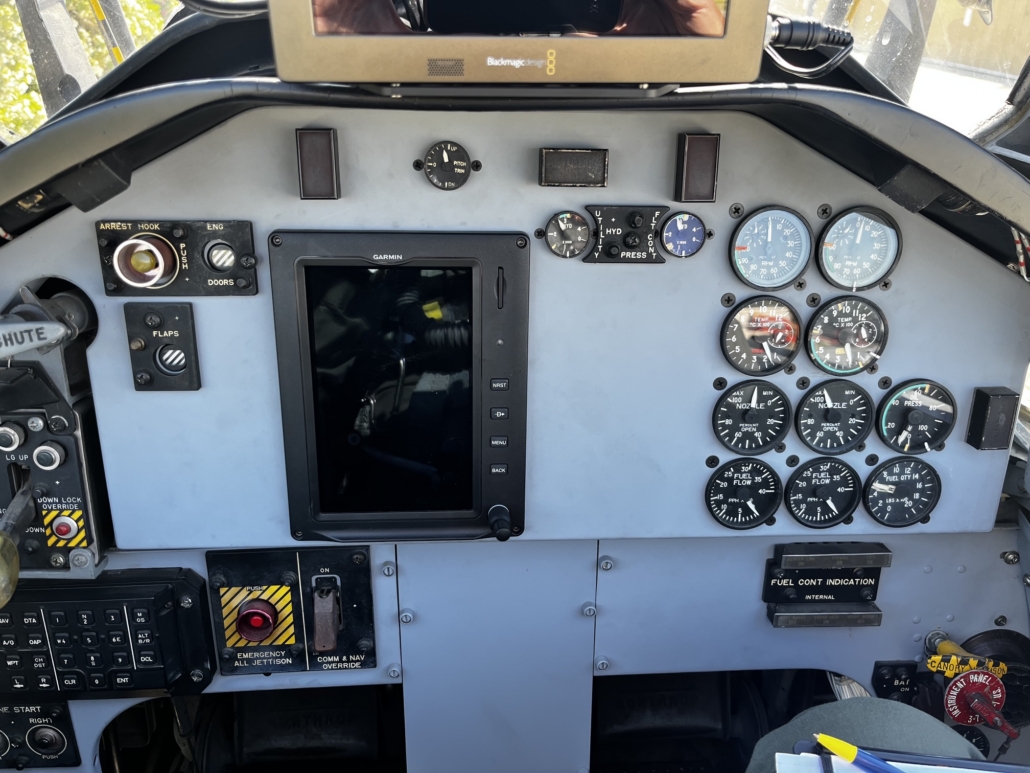
Back seat panel for CF-5D.
The afternoon sessions on day one covered aircraft-specific information, particularly aircraft flight controls, canopy operation and controls, and the well-known escape system. The Northrop “Improved” rocket-powered ejection seat system was manufactured by the aircraft manufacturer, Northrop. The familiarization continues with more stuff your life depends on, including seat restraints, helmet, comm systems, ejection seat handle and operation, and parachute. That last item is key if you need to eject from a jet and covers parachute deployment, descent, and landing following an in-flight emergency. Much of this was familiar to me from my previous military flight history, but it was great to review again.
The second day started with a detailed flight brief reviewing all the details and maneuvers. Next was the cockpit checkout covering all the systems to reinforce emergency system procedures, canopy security, ejection seat operation, avionics, comm system checks, oxygen check, HUD repeater use, helmet fit and connections to the aircraft, flight controls, and much more. Finally, it was time to suit up and slip the surly bonds of Earth.
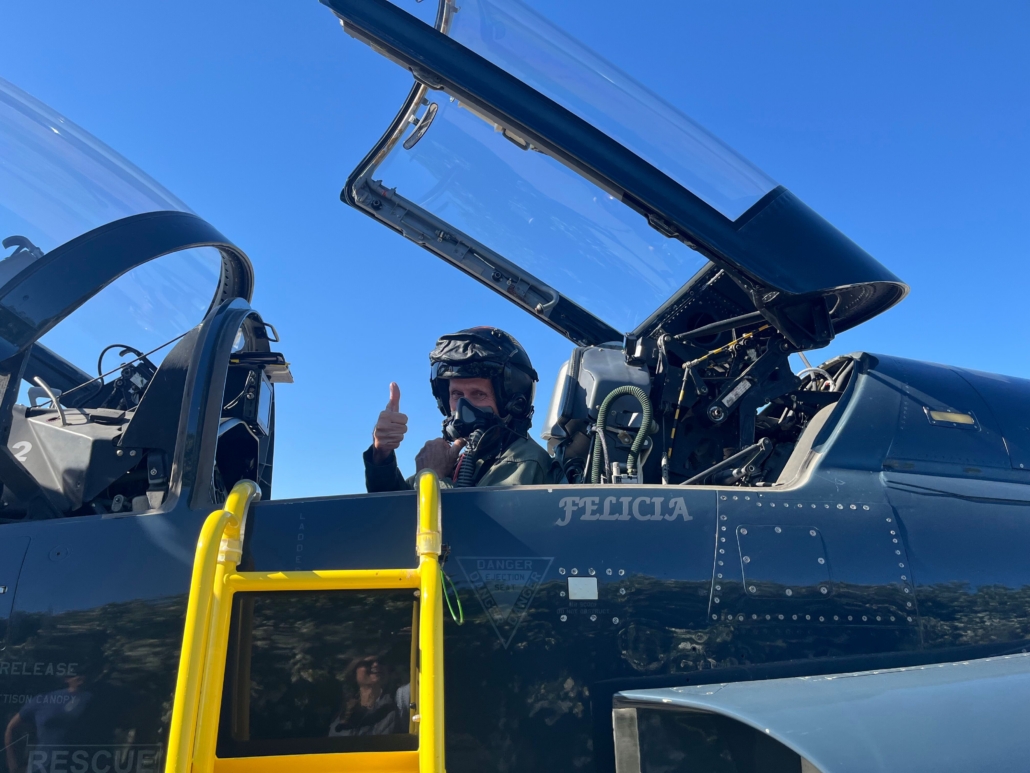
PaddyO in back seat with helmet on ready to head out to runway 30 KMHV.
Walking up to the 47-foot-long CF-5D with its thin, 26-foot swept wings, it just screams of speed. I couldn’t wait for the best part. Suited up and strapped in, Gomex and PaddyO taxied to Runway 30 at Mojave for departure. The rotation at 155 KIAS and climbout were smooth and powerful, just as I remembered on other jets. Then Mojave Tower handed us off to Joshua Approach for entry into R-2508 airspace, followed by transfer to SPORT for R-2515 entry. Along the way, G warm-up maneuvers were performed with turns to pull 4 Gs. The F-5 structural/aerobatic maneuvering load factor limits are +7 Gs positive/-3 Gs negative. People often ask about adapting to the Gs, but it isn’t a big factor for me as I often pull 3.5-4 Gs in my normal flying. The view at altitude over the desert was spectacular. Flying qualities of the F-5 were also checked, with rudder and aileron effectiveness evaluated while climbing to FL340.
CF-5D in flight.
Continuing the climb, we passed abeam Three Sisters (a small but distinctive group of mountains) and made a right turn in afterburner to enter BX1SC for the transonic run. The General Electric J85 turbojet-powered engines are powerful, producing 2,925 pounds of thrust in military (MIL) power and 4,300 pounds at maximum afterburner (MAX). In transonic flight, the flight controls are extraordinarily sensitive, so small stick inputs produce dramatic pitch or roll changes. Although I had flown in many Navy jets, very high-speed flights were rarely available in the airspace around Washington, D.C., and the Maryland Eastern Shore region, so this was a special treat. My only previous time at high Mach number was aboard a Concorde from New York to Paris, with a glass of champagne in hand. I would choose the F-5 option every time.
We returned to R-2508 to continue flying quality evaluations. The stall series is always important in any aircraft because it lets you experience aircraft handling qualities at slow speed and high angle of attack (AoA). We performed stalls in the landing configuration and accelerated stalls as well. It also provides an opportunity to evaluate aileron and rudder effectiveness at high AoA.
Rolls are just pure fun and a pretty easy aerobatic maneuver to perform. Both aileron and rudder rolls were performed. But what blew my mind was the roll rate of up to 720 degrees/second. Rolls in my RV-8 are responsive at 140 degrees/second, and I have also done rolls in an L-39 at 300 degrees/second. But 720 degrees/second in the F-5 was an entire world unto itself. That’s two complete turns in one second and on par with what I previously thought was the highest roll rate with the A-4 Scooter. It took effort to acclimate to such a fast roll rate, especially when pushing past the aileron limiter/spring stop to get to 720 degrees per second. What a thrill!
The yaw doublets used to excite the Dutch Roll mode were interesting, even if I was a little too aggressive on the rudder inputs. All the while we were flying these maneuvers, we received constant traffic advisories from Joshua Approach regarding other military aircraft, mostly F-16s, and there was a lot of traffic in the restricted area.
The hour-plus flight passed quickly, and it was soon time to return to Mojave. Scott let me fly a good portion of the flight, which I greatly appreciated. I flew us into the downwind to Runway 30 and handed the plane to Scott for the final approach. The landing at 150 KIAS was as sweet as the takeoff and the entire flight.
Scott and his Aerospace Operations team offer a superb training experience with a thorough ground school and inflight experience. While I had long anticipated an F-5 hop, it was even better than I ever expected. So much better that I’m ready to go again!
While the F-5 hop is near the top of my experiences, I can’t stop there. I’m thinking that a sailplane rating is in my immediate future. Never stop learning, living, and adding to that bucket list!
PaddyO at nose of the CF-5D excited for this bucket list hop.
The post Finally Flying the F-5: A Bucket List Item appeared first on Air Facts Journal.
https://airfactsjournal.com/2026/10/finally-flying-the-f-5-a-bucket-list-item/
#bucketlist #listitem #finallyflying #carriersuitability #itemair #navy #airfacts #test #factsjournal #starwars
#rss #feeds #linksharing #qwibbit