APOD on Nostr: **Astronomy Picture of the Day** 22 October 2026 **The First Green Star, WD ...
**Astronomy Picture of the Day**
22 October 2026
**The First Green Star, WD J1330+6435**
Image:
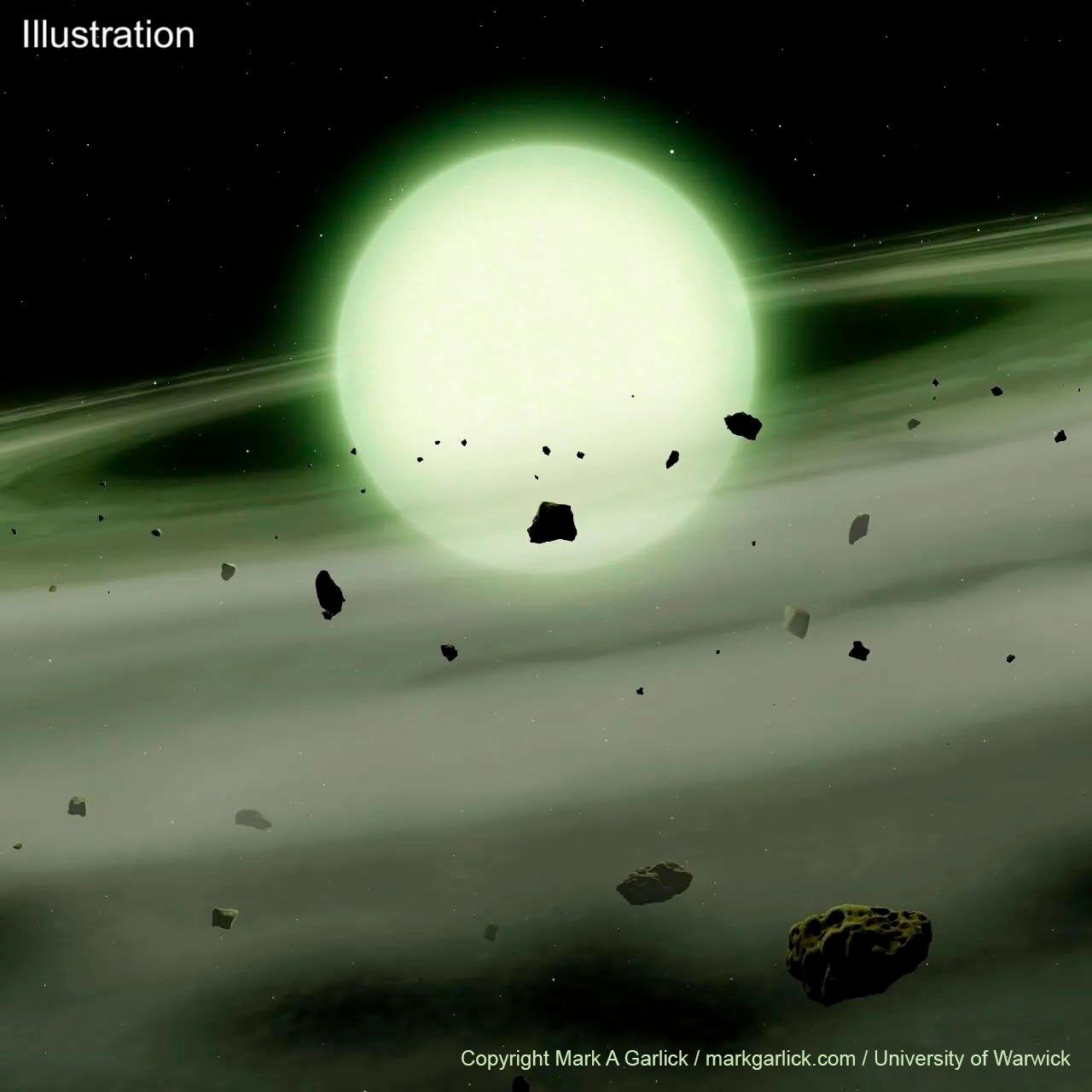
Credit: Mark A. Garlick, University of Warwick
Explanation: Explanation: Star light, star bright: is there a green star out tonight? Other than the Sun , all stars are so far from Earth that they appear as points in the sky. They are mostly white, but sometimes noticeably red or blue . This color typically relates to the temperature: blue stars are hotter than red stars. What about other colors? The featured image is an illustration showing WD J1330+6435 , a white dwarf star , surrounded by an accretion disk with gas and rocks orbiting the star. White dwarfs are small, faint stars that are left over when a star like the Sun exhausts its nuclear fuel . Astronomers recently found that some white dwarf stars, despite their name, would appear yellow, green, cyan, pink, or purple . In these cases , trace elements that were accreted to these stars interact with the stellar atmosphere and shift its normally white color. But, alas! I wish I may, I wish I might, but they are too faint to see tonight ... Tomorrow's picture: eye in the sky
#APOD #NASA #lookUp #Astronomy
https://science.nasa.gov/image-article/apod-2026-october-22-the-first-green-star-wd-j13306435/Published at
2026-10-22 04:06:32 UTCEvent JSON
{
"id": "d42e9cce221c4b9eb8c81fe5e26f43e179c7317f1067b7b3d099e7c8747d7678",
"pubkey": "e85ed75286cb77475776c1007df8c4ff1c9c68eff91c3627347b065c5bf4dc78",
"created_at": 1792641992,
"kind": 1,
"tags": [],
"content": "**Astronomy Picture of the Day**\n\n22 October 2026\n\n**The First Green Star, WD J1330+6435**\n\nImage: https://assets.science.nasa.gov/dynamicimage/assets/science/cds/apod/apod/2026/october/green_wd_mark-garlick_annotated2.jpg\n\nCredit: Mark A. Garlick, University of Warwick\n\nExplanation: Explanation: Star light, star bright: is there a green star out tonight? Other than the Sun , all stars are so far from Earth that they appear as points in the sky. They are mostly white, but sometimes noticeably red or blue . This color typically relates to the temperature: blue stars are hotter than red stars. What about other colors? The featured image is an illustration showing WD J1330+6435 , a white dwarf star , surrounded by an accretion disk with gas and rocks orbiting the star. White dwarfs are small, faint stars that are left over when a star like the Sun exhausts its nuclear fuel . Astronomers recently found that some white dwarf stars, despite their name, would appear yellow, green, cyan, pink, or purple . In these cases , trace elements that were accreted to these stars interact with the stellar atmosphere and shift its normally white color. But, alas! I wish I may, I wish I might, but they are too faint to see tonight ... Tomorrow's picture: eye in the sky\n\n#APOD #NASA #lookUp #Astronomy\n\nhttps://science.nasa.gov/image-article/apod-2026-october-22-the-first-green-star-wd-j13306435/\n",
"sig": "bf48af0b8d8be430cbb5bcc388aac382a0814d14b96a40a822e739cccf87a0a571de78edddb9dfe84d9b2bb5ac999e81503c81b5b3887e5402d5bbc34cb4ed13"
}
