Event JSON
{
"id": "7fa1cc00faade249cdebdf7bc1dd7206c8d266531bb73da7f8aa261cb1ddb4e8",
"pubkey": "f06c0d239b29f2884d1a345bd1e120125610976d968e6002bb324116b70fc39e",
"created_at": 1744036505,
"kind": 1,
"tags": [
[
"imeta",
"url https://m.universetoday.com/system/media_attachments/files/114/297/176/418/805/116/original/110fe082139d1576.webp",
"m image/webp"
],
[
"proxy",
"https://m.universetoday.com/@fraser/114297176432265135",
"web"
],
[
"proxy",
"https://m.universetoday.com/users/fraser/statuses/114297176432265135",
"activitypub"
],
[
"L",
"pink.momostr"
],
[
"l",
"pink.momostr.activitypub:https://m.universetoday.com/users/fraser/statuses/114297176432265135",
"pink.momostr"
],
[
"-"
]
],
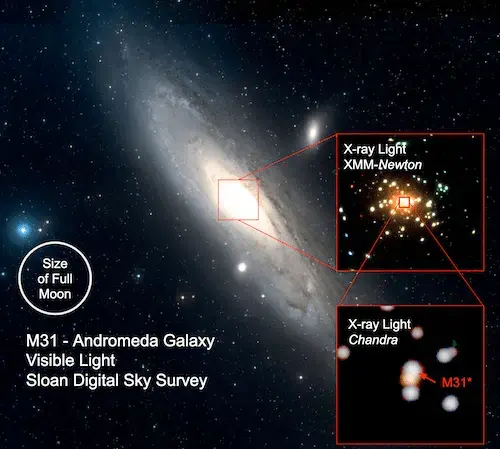
"content": "Astronomers have measured a flicker of X-ray radiation coming from the supermassive black hole at the heart of the Andromeda Galaxy. Their observations were made with the Chandra X-ray Observatory, collated from 15 years of data, and highlighted two powerful flares in 2006 and 2013. These flashes matched a burst of neutrinos detected by the IceCube Neutrino Observatory, giving new insights into conditions around the supermassive black hole.\n\nhttps://msutoday.msu.edu/news/2025/when-a-black-hole-winks-at-you\nhttps://m.universetoday.com/system/media_attachments/files/114/297/176/418/805/116/original/110fe082139d1576.webp\n",
"sig": "37df61af4c7a7d7c5ef0daf8c76c2ac78e9e44e472bd7cc97907bfbf74d49659d93393cab2da153409f7fade5e109b9c7a511aa977e9b4f7d0805cdfba1e5783"
}