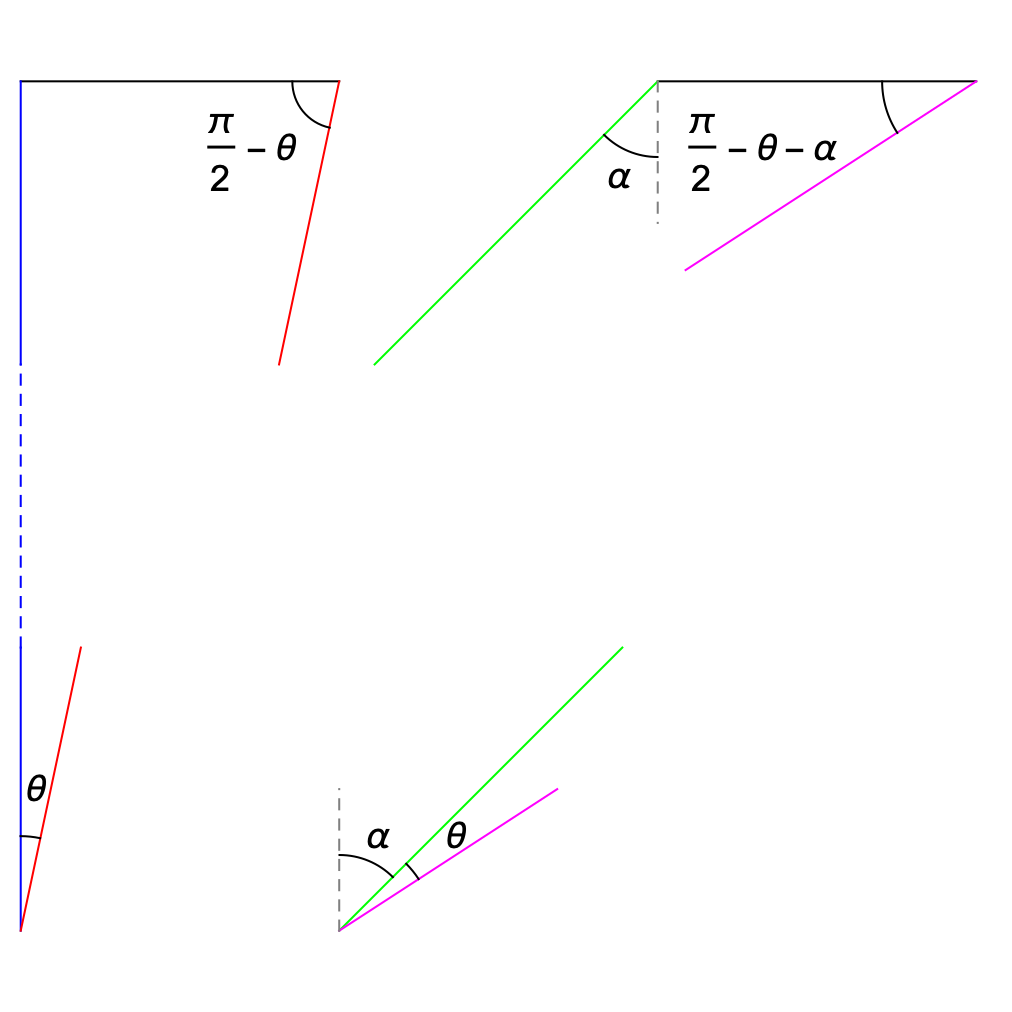
In the first case, the red and blue sides of a right triangle approach the same length as θ→0.
In the 2nd, it’s not a right triangle, and the limit of (magenta-green) depends on α.
In our clock experiment, spacetime geometry is Lorentzian not Euclidean, so the difference is reversed: the magenta helix that represents the world line of a travelling clock always records slightly LESS time than the green helix of a clock only rotating with the Earth.
(The blue line and the red helix represent what would happen if the Earth was not rotating at all: by carrying the clock slowly enough, you could make the times as close as you like.)
If you travel around the equator (slowly, at constant altitude) west instead of east, the roles of the green and magenta helices are reversed, and the travelling clock records ~200 nanoseconds more time than the one that stayed fixed to the rotating Earth.
I compute this time difference as part of the “Ordinary rotation” section here:
https://gregegan.net/SCIENCE/BornRigid/BornRigid.html
Δτ = 2πω R^2 / √[1 – ω^2 R^2]
in units where c=1, or in conventional units:
Δτ = 2πω (R^2 / c^2) / √[1 – ω^2 R^2 / c^2]
R is the radius of the Earth, ω its angular velocity.