Event JSON
{
"id": "7f11b3027764d5a161bf60ff6c8c51e5364d48e6f46288e79cef5369daf650cb",
"pubkey": "563821004c3e4e4f4fbef74a2657db3299a0e71a78214bf97db0b6ca05fb73d3",
"created_at": 1787135389,
"kind": 1,
"tags": [
[
"imeta",
"url https://media.mathstodon.xyz/media_attachments/files/117/121/694/535/886/588/original/c1cefbab0c055171.png",
"m image/png"
],
[
"proxy",
"https://mathstodon.xyz/@gregeganSF/117121704869961550",
"web"
],
[
"proxy",
"https://mathstodon.xyz/users/gregeganSF/statuses/117121704869961550",
"activitypub"
],
[
"L",
"pink.momostr"
],
[
"l",
"pink.momostr.activitypub:https://mathstodon.xyz/users/gregeganSF/statuses/117121704869961550",
"pink.momostr"
],
[
"-"
]
],
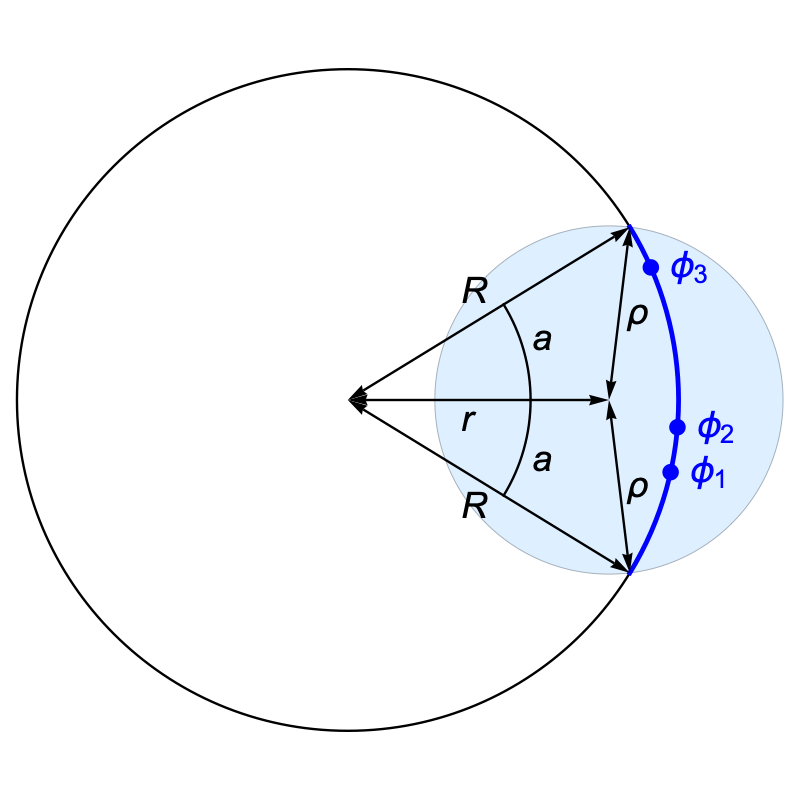
"content": "If you pick 3 points at random on a unit sphere, the average radius, R, of the circle that contains them is 7/6.\n\nFor 3 points on a flat disk of radius ρ, mean(R) diverges. However, the curvature, κ = 1/R, has a finite mean which can be computed exactly:\n\n16 (3 – 16/π^2) / (15ρ)\n\nAlthough it’s easy to write down the radius of the circle through any 3 points, given their coordinates, integrating the reciprocal of this over all triples of points inside a disk is unwieldy.\n\nIt’s easier to switch to a coordinate system where R is one of the coordinates, along with the location of the centre of the circle and the positions of the 3 points around the circle.\n\nDetails at https://www.gregegan.net/SCIENCE/ThreePointCurvature/ThreePointCurvature.html\nhttps://media.mathstodon.xyz/media_attachments/files/117/121/694/535/886/588/original/c1cefbab0c055171.png\n",
"sig": "fcd2855850cda07285bd779897e6c2f94cf39ef4b66d00d9db81db0bb79ef21ae81bbae6703e4d249c74d114fa7268b0ad56e97e2286f4ae29fd94ebc99f2e9d"
}