Event JSON
{
"id": "a822c6c9140efd0e9c21477a472957edf5a0efff76beeecf940ab1cd4ec36506",
"pubkey": "2eab6364ce6177c1d9bdad2e0f5550d4c24a7b7fdb433d6cd382c5034d9059b1",
"created_at": 1743661664,
"kind": 1,
"tags": [
[
"t",
"bats"
],
[
"t",
"echolocation"
],
[
"imeta",
"url https://cdn.masto.host/scholarsocial/media_attachments/files/114/272/608/693/989/112/original/487c9234c0e40984.webp",
"m image/webp",
"dim 800x530",
"blurhash UB7BP}-;aexa~p-:j?xa_2%Mfit7?bt7R*t7"
],
[
"proxy",
"https://scholar.social/users/animalculum/statuses/114272610860908774",
"activitypub"
]
],
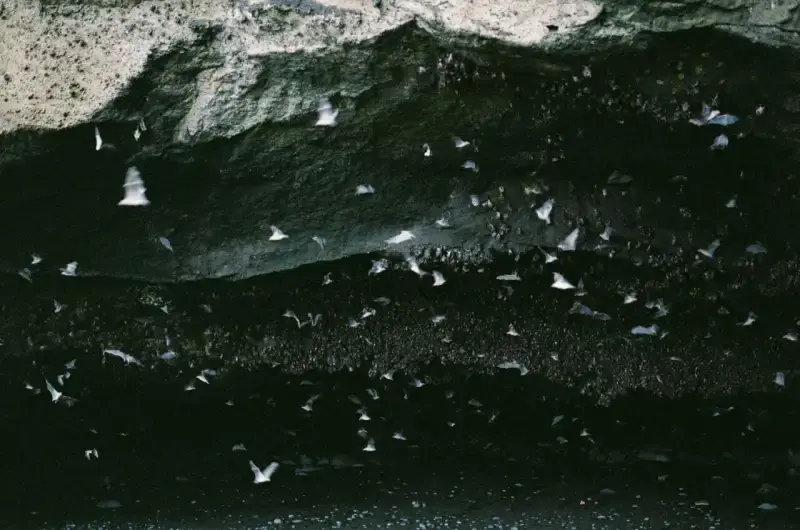
"content": "Bats' echolocation strategy: How dense colonies avoid mid-air collisions\nhttps://phys.org/news/2025-03-echolocation-strategy-dense-colonies-mid.html paper: https://www.pnas.org/doi/10.1073/pnas.2407810122\n\n\"When exiting the cave, #bats experience a cacophony of calls, with 94% of echolocations being jammed. Yet, within five seconds of leaving the cave, bats significantly reduced the #echolocation jamming... they fanned out and they emitted shorter and weaker calls at higher frequency... to gain detailed information about their near neighbors... to avoid collisions.\"\n\nhttps://cdn.masto.host/scholarsocial/media_attachments/files/114/272/608/693/989/112/original/487c9234c0e40984.webp",
"sig": "7ac976141a696bfba5145be6d1173d0dbc7c128573f1f18db784e18a301758bfc4d2ef6b541d6877d89d3a43618f739511c4b99cd5d387a9b1c614b51265a32a"
}