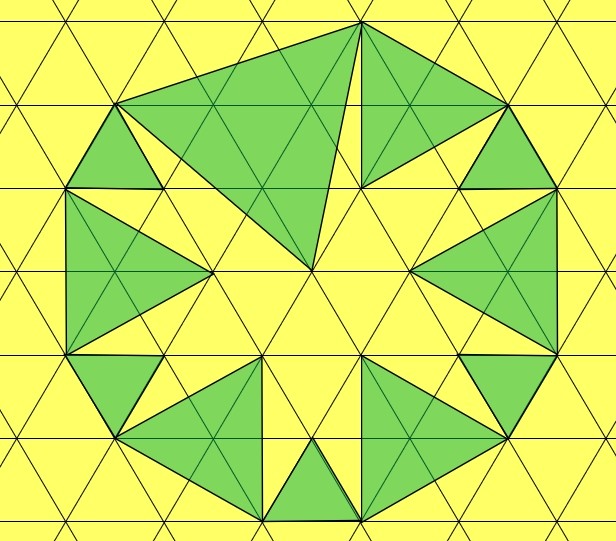
Here is the icosahedron cut out without the text. All the black gridlines are fold lines.
I think I am starting to understand this a bit better.
Suppose you have a “Generalised Buckyball”. It always has exactly 12 vertices where 5 triangles meet. Choose 1, call it the “North Pole”. Then draw geodesics from the North Pole to the other 11 5-nodes. Then cut out along these geodesic segments. It should now fold flat on the table, because all the non-zero Gaussian curvature points have been cut open. The geodesics will be straight lines when folded flat, and they will meet at 60 degree angles. So you get Thurston’s 11-gon.
There may be some trouble if several 5-nodes lie exactly on the same geodesics. We may have to choose a different North pole. You would have to prove this always works, but it works in practice in all cases I can think of.