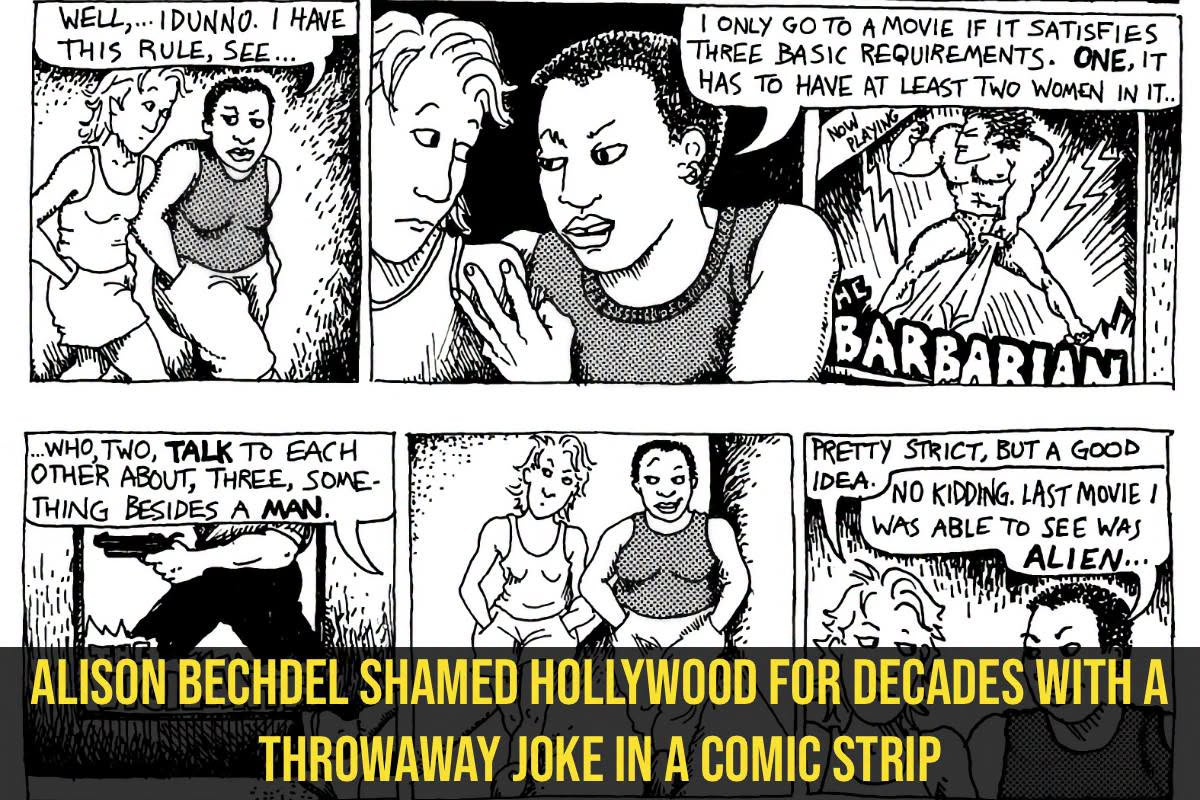
"A lot of folks know the Bechdel Test. But did you know it comes from a throwaway joke in a lesbian comic strip?
In 1985, Alison Bechdel published a "Dykes to Watch Out For" strip where two women discuss which movie to see. One of them has three simple rules. The movie has to feature at least two women. They have to talk to each other. And they have to talk about something besides a man. They leave without buying a ticket because almost no movies qualify.
It was funny because it was true.
Four decades later, Hollywood still often struggles to clear a bar that low.
The irony is that the “Bechdel Test” was never meant to be a serious grading system for art. Bechdel herself has pointed out that plenty of great movies fail it, while plenty of terrible movies pass. The joke simply exposed how often women, especially queer women, disappeared from stories altogether. Once you notice it, you cannot stop noticing it.
Bechdel started Dykes to Watch Out For in 1983, at a time when openly lesbian characters were mostly invisible in newspapers. The strip followed a circle of friends as they navigated relationships, politics, jobs, activism, and everyday life. There were breakups, elections, bookstore gossip, debates over feminism, and endless coffee conversations. It was funny, messy, and deeply human.
Most importantly, queer people were never treated as side characters in someone else’s story. They were the story.
The comic ran for more than 25 years and documented enormous changes in LGBTQ life. Readers watched characters confront the AIDS crisis, fight over marriage equality, argue about race and class, come out, grow older, have children, and wrestle with the same contradictions the rest of us do. Reading the archives today feels like flipping through an illustrated history of modern queer America.
In 2006, Bechdel published "Fun Home," a graphic memoir about growing up in rural Pennsylvania with a closeted father whose death forced her to reconsider her family’s entire history. It was funny in places, devastating in others, and unlike anything many readers had encountered. A comic book had become serious literature without sacrificing the visual storytelling that made comics unique.
"Fun Home" spent two weeks on The New York Times Best Sellers list, became a staple of college classrooms, and eventually won five Tony Awards after being adapted into a Broadway musical.
Not bad for a medium many people once dismissed as funny pages.
Alison Bechdel did not just create memorable characters. She changed the language we use to talk about representation. She proved comics could carry the emotional weight of the best novels. And she reminded generations of queer readers that our ordinary lives, our friendships, our family drama, and our inside jokes were always worth putting on the page. "
#AlisonBechdel #Lesbian #Lesbians #LesbianHerstory #SecondWaveFeminism #Feminism #Feminist #RadicalFeminist #RadFem