I wrote about “fascism grief” in my last post, but in a third-person voice, urging that this particular variety of grief be named. Not only do many forms of losses get ignored and not mourned, but not all types of grief are the same.
Which brings me to a short, first-person “accounting” of (some) fascism griefs for me:
1. It’s massively bringing up my Jewish (but also queer, anarchist, and diasporic) ancestral grief over what past European fascism killed off: lost family, lost places and cultures, lost histories, lost radical political movements, and lost possibilities (without the Holocaust, I’d wage there never would have been a state of Israel and thus the [ongoing] Nakba), but how family and the wider Jewish world that “survived” the Holocaust was traumatized too, passing that messy pain along to the present, making for more loss of family and friends now (not dead, but unable to be in relation with me because they’ve turned toward fascistic sentiments rather than face their own ancestral trauma).
2. It elicits fear, not merely for myself, but for nearly everyone I know and most of humanity—causing a lost sense of futurity
3. Sense of abandonment—related to ancestral trauma, yet tied to how fractured and atomized many people and communities have become. Meaning loss of feeling that solidarity will hold me/us.
4. Which connects to a new (for me) sense of paranoia. Who and what can I really trust beyond small circles? Meaning, relatedly, a huge loss of openness.
5. When all feels dangerous, how does one make decisions, for the wrong choice about what to do, how to resist, where to be, who to associate with, etc., now feels potentially harmful or deadly. Hence a loss of the ability to think/dream forward, replaced by indecisiveness and stuckness.
6. Emotional dissociation—rare for me, and so it feels confusing. Grief is shutting down my emotional range, which feels a loss when I know that, say, crying would help.
7. Anger and impatience—at liberals and others who can’t see and/or admit we’re under fascism, and thereby act accordingly, versus (unthinkingly?) aiding and abetting fascism’s grip.
8. Fascism grief is so much different/worse when it’s felt not in a theoretical but instead visceral way.
🥀🥀🥀
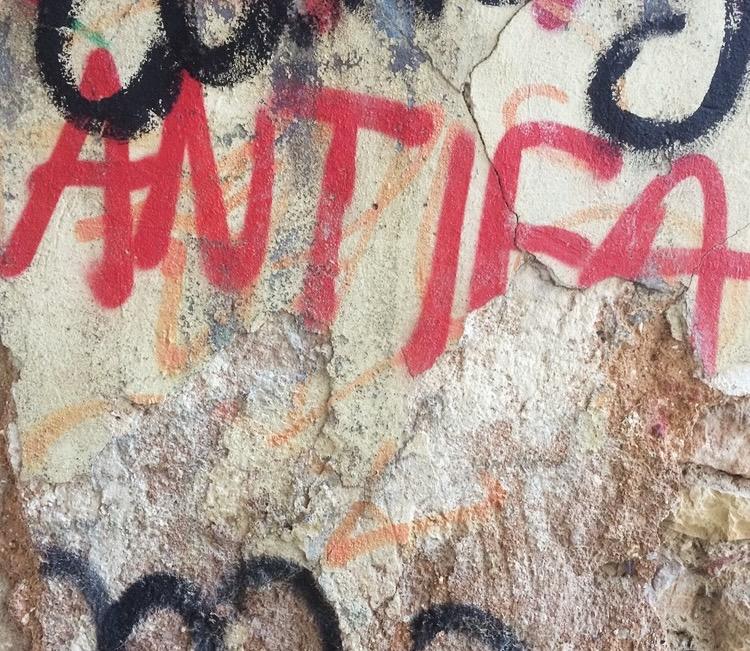
photo: “Antifa” tag, sadly worse for the wear and tear of trying to hang onto a crumbling wall, Athens, November 2019